Heatoor wins — and it wins a comparison of two, not of the whole market
- It is the only one of the three with a positive, checkable public record on its own brand domain: TrustScore 4.0 out of 5 from 94 reviews on Trustpilot, a claimed profile whose owner replies to 84% of critical reviews.
- It is the only one with a stated manufacturer warranty — 1 year, limited — on top of the 30-day money-back window everyone offers.
- It is the only one that does anything in summer: it has a fan-only mode, which changes the value calculation for a device you would otherwise store for eight months.
- It costs 2.8× more than the alternative, and like the others it publishes no wattage, no voltage and no safety certification. That is why it scores 2.8 and not 4.
HeatNest documentary score: 2.8/5

Before the first link: how we are paid
All three products on this page pay HeatNest the same fixed commission — US$ 70 per sale, regardless of which one you buy or how many units. There is no product here we earn more on, so there is nothing for the ranking to be bought with. We were not sent any unit, we were not paid to review anything, and no seller saw this page before publication. Because every product here is a paying one, we call this page “the three we compared”, not “the best on the market” — we have not surveyed the whole category.
Quick buying decision: which option fits you?
Heatoor
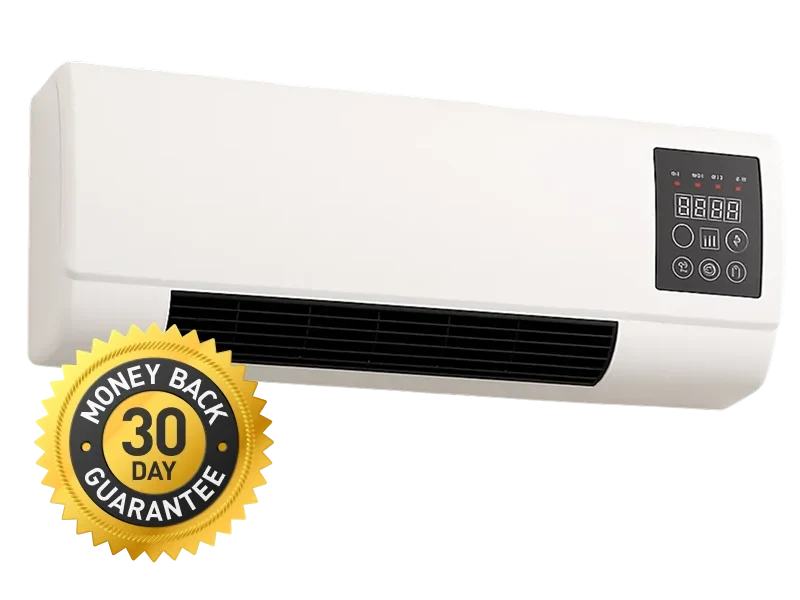
- Wall-mounted electric heater with remote control
- Seller publishes fan-only mode, timer and thermostat
- Useful for buyers who care more about warranty than entry price
Best fit if you value a manufacturer warranty, a fan-only summer mode and a better documented public track record more than the lowest upfront price.
WellHeater / VelaWarm
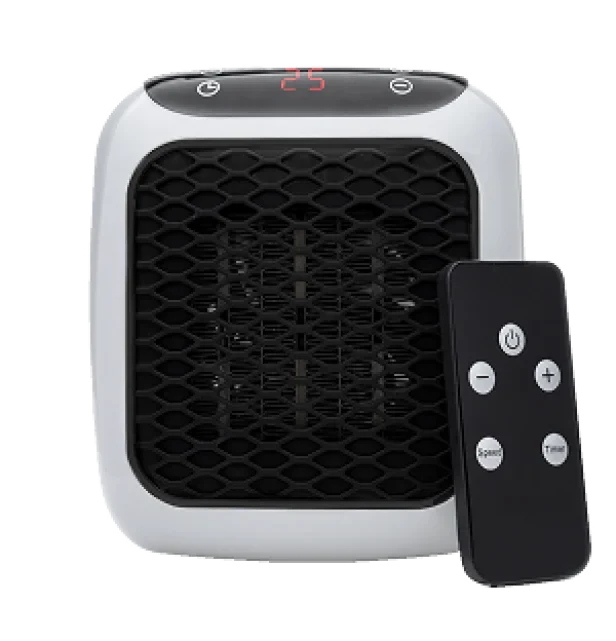
- Compact plug-in format with remote control
- Seller publishes thermostat, timer and reusable filter
- Lower entry price, but a much weaker public track record
Best fit if your priority is the lowest entry price for a compact heater with thermostat, timer and remote, and you accept the weaker public record.
Before you buy: neither seller publishes wattage or voltage on the pages we checked. For an international order, confirm the shipped voltage in writing.
The comparison at a glance
Everything below is taken from the sellers' own pages and from Trustpilot, on 12 September 2026. Blank cells are not omissions on our part — they are facts the manufacturer does not publish anywhere on its site.
| Heatoor | WellHeater / VelaWarm | |
|---|---|---|
| Our score | 2.8 / 5 | 1.9 / 5 |
| Price, 1 unit | $137.99 | $49.99 |
| Best bundle price per unit | $89.99 (3 units) | $34.37 (4 units) |
| Independent rating | 4.0 / 5 — 94 reviews | 1.8 / 5 — 577 reviews (WellHeater); none published for VelaWarm |
| Claimed coverage | 50 m² (538 sq ft) | 12 m² (130 sq ft) |
| Heating element | PTC ceramic | Ceramic plates |
| Summer fan mode | Yes | No |
| Thermostat, timer, remote | Yes | Yes |
| Wall-mount kit included | Yes | No |
| Antimicrobial filter | Not mentioned | Yes |
| Money-back window | 30 days | 30 days |
| Manufacturer warranty | 1 year, limited | Not stated |
| Power rating (W) | Not published | Not published |
| Voltage (110 / 220 V) | Not published | Not published |
| Safety certification | Not published | Not published |
| Dimensions and weight | Not published | Not published |
Recorded 12 September 2026. Prices are in US dollars, as stated by the sellers. The amount that appears on your card may differ if your country uses another currency — see “Delivery, voltage, returns” below.
The ranking
Two entries, scored on the weights above. Each block says what the product wins on and what it loses on, with the source for both.
Heatoor
The expensive one with the only decent public record — and the only one that is useful in July.
Heatoor is a plug-in PTC ceramic heater with a remote, a timer, a touch panel, 360° air circulation, a wall-mount kit in the box and — unusually for this category — a fan-only mode for summer. The seller claims coverage up to 50 m², states a 30-day money-back guarantee and a 1-year limited warranty, and ships internationally.
Its real advantage is not in the spec list. It is that Heatoor is the only product here whose own brand domain carries a positive independent record. Trustpilot shows a TrustScore of 4.0 out of 5 from 94 reviews for heatoor.com, on a profile the company claimed in December 2025, and the company replies to 84% of the critical reviews it receives. Ninety-four reviews is a thin record, and 13% of them are one star — but it is a real, checkable one, and a seller that answers complaints in public is a seller you have somewhere to go with a problem.
The honest caveat sits on a second domain. Trustpilot also carries a profile for heatoor.ca — the Canadian storefront — with a TrustScore of 2.0 from 13 reviews, eleven of them one star, on an unclaimed profile marked as closed. The complaints there are about currency conversion, delivery times and return costs rather than the hardware. It is a small sample and the shop no longer operates, but a buyer deserves to know it is there.
And then the thing Heatoor shares with every product on this page: it publishes no wattage, no voltage and no certification mark. At $137.99 for a single unit, that is a lot of money for a heater whose power you will only discover when you unbox it.
What holds up
- The only positive, verifiable independent record here — 4.0 from 94 reviews
- The seller answers 84% of critical reviews in public
- The only 1-year manufacturer warranty on this page
- Fan mode means it is not dead weight for eight months of the year
- Wall-mount kit included, so it need not occupy floor space
Where it falls short
- 2.8× the price of the alternative for one unit
- No wattage, voltage or certification published — the 50 m² claim cannot be verified
- The 50 m² coverage figure is implausible for any single socket-powered heater
- The closed Canadian storefront sits at 2.0 from 13 reviews
- 94 reviews is still a thin record for a purchase at this price
Affiliate link · US$ 70 commission, the same as every product on this page
WellHeater / VelaWarm
One device, two names, and by far the lowest price on this page.
A compact plug-in ceramic heater with an adjustable thermostat, timer, remote control, an antimicrobial air filter, overheat protection and a cool-touch casing. Claimed coverage is 130 sq ft, about 12 m² — a bedroom, a home office, a bathroom. Sold with a 30-day money-back guarantee. As set out above, it is sold identically under both the WellHeater and VelaWarm brands.
What it wins on is straightforward and real: price. At $49.99 for one unit and $34.37 per unit in a pack of four, nothing else here is close. If your problem is three cold rooms rather than one, this is the only option on the page that solves it for the price of a single competing unit.
What it loses on is equally straightforward. The public record under the WellHeater name is the weakest on this page by a wide margin: Trustpilot shows a TrustScore of 1.8 out of 5 across 577 reviews, with 87% of them at one star, on a profile the company claimed in September 2024. The recurring themes in those reviews are the checkout and the aftermath rather than the heater itself — orders duplicated at checkout, prices shown in one currency and charged in another, units arriving at the wrong voltage for the destination country, and slow refunds.
Under the VelaWarm name there is no independent record to weigh at all. The Trustpilot profile that existed for a VelaWarm review domain has been removed by the platform for breaching its guidelines. We mention this not as a verdict on the hardware but because the absence is easy to misread as a clean sheet.
And, like the Heatoor, it publishes no wattage, no voltage and no certification.
What holds up
- By far the lowest price here — $49.99 for one unit
- Four units cost less than one Heatoor, which makes multi-room heating affordable
- Thermostat, timer and remote are all included at that price
- Antimicrobial filter and cool-touch casing are claimed as standard
- Same 30-day money-back window as the more expensive option
Where it falls short
- TrustScore 1.8 out of 5 from 577 reviews under the WellHeater name, 87% at one star
- No independent record at all under the VelaWarm name
- No wattage, voltage or certification published
- No manufacturer warranty stated — only the 30-day window
- Claimed coverage of 12 m² is modest; it will not heat an open-plan space
Affiliate link · US$ 70 commission, the same as every product on this page
What they actually cost
All prices are in US dollars and come from the sellers' own bundle pages, recorded on 12 September 2026.
Heatoor
WellHeater / VelaWarm — identical on both brands
Price per claimed square metre tells the opposite story, and both halves are worth seeing. Heatoor: $137.99 for a claimed 50 m² is $2.76 per m². WellHeater: $49.99 for a claimed 12 m² is $4.14 per m². On the sellers' own numbers, the expensive heater is the better value.
But that calculation rests entirely on the 50 m² figure, which is the least credible number on either page and cannot be checked without a wattage. This is exactly why we put technical transparency at 20% of the score. A specification you cannot verify is not a specification — it is a claim, and a claim that happens to make the more expensive product look like the bargain.

Best for each case
Neither of these is the right answer for everyone, so here is where each one genuinely wins.
| If your situation is… | Pick | Because |
|---|---|---|
| You want the safest bet overall | Heatoor | The only positive independent record, plus a 1-year warranty and a seller who answers complaints |
| You want the lowest price | WellHeater / VelaWarm | $49.99 for one unit |
| You have several cold rooms | WellHeater / VelaWarm | Four units for $137.48 — the price of one competing heater |
| You want it useful all year | Heatoor | The fan-only mode is the only summer function on this page |
| You want the least risk if it goes wrong | Heatoor | 30 days money back plus 1 year of manufacturer warranty, and a seller that replies publicly |
| You want a published wattage before you buy | Neither | No seller on this page publishes one. Buy from a retailer that does. |
Delivery, voltage and returns — read this before you order
These are international direct-to-consumer offers, which is genuinely useful if you live somewhere the big heater brands do not ship. It also creates three specific problems that come up again and again in the public reviews of all three sellers, and all three are avoidable if you know about them in advance.

1. The currency you are charged. Both sellers price in US dollars. Buyers in Australia, Canada and New Zealand have repeatedly reported seeing a figure they read as their local currency and being charged the US-dollar amount instead, plus their bank's conversion fee. Before confirming, check the currency code next to the total, and check the amount that appears in your banking app afterwards.
2. The voltage you receive. Neither seller publishes the voltage of the unit it ships. Buyers in 230–240 V countries have reported receiving 110 V units, which are not usable there and are not made safe by a plug adapter — a plug adapter changes the pin shape, not the voltage. If you are outside the 110–120 V world, ask the seller in writing which voltage will be shipped to your address before you order, and keep the answer.
3. Cancelling and returning. Buyers have reported being told an order could not be cancelled within minutes of placing it. Treat the purchase as final from the moment you confirm, and rely on the 30-day money-back window rather than on cancellation. Check who pays return shipping before you commit — on international returns that cost can be a meaningful fraction of a $49.99 heater.
If you are in the EU or the UK, your statutory right to withdraw from a distance purchase exists independently of whatever window the seller advertises. It is worth knowing that before you need it.
How to choose, in four questions
If you would rather not read the whole page, these four questions settle it.
How big is the room, actually?
Measure it. A plug-in heater is a supplementary device for one room — typically somewhere between 10 and 20 m² for a single socket-powered unit. If you are trying to warm an open-plan living area, no product on this page is the right tool, whatever its page claims.
Will you turn the central heating down while it runs?
If yes, a plug-in heater can genuinely lower your bill by heating only the room you occupy. If no — if it is going on top of your normal heating — it will raise your bill by exactly what it draws, and no brand on this page or anywhere else changes that.
One room or several?
One room, and you value having somewhere to complain: Heatoor. Several rooms, on a budget: four WellHeater units cost the same as one Heatoor. This is the single biggest fork in the decision.
What voltage is your country on?
If you are on 230–240 V, get the shipped voltage confirmed in writing before ordering from any of these sellers. This is the most common serious complaint across all three public records, and it is the one that leaves you with an unusable box.
How we scored them
The weights below were fixed before we scored anything, and they are the whole method. We did not test these heaters: no unit was sent to us and we did not buy one. This is a documentary comparison — published specifications, purchase conditions, and public reputation that anyone can check from the links at the bottom of this page.
That sounds like a limitation, and it partly is. But in this category the valuable work is not switching a heater on. It is reading what the seller does and does not put in writing, which almost nobody does.
| Criterion | Weight | How it is verified |
|---|---|---|
| Verifiable independent reputation | 30% | Trustpilot profile on the brand's own domain — score, number of reviews, whether the profile is claimed, and whether the seller answers criticism |
| Technical transparency | 20% | Does the seller publish wattage, voltage, safety certification, dimensions and weight? |
| Purchase conditions | 20% | Currency actually charged, clarity of the checkout, whether an order can be cancelled, refund handling — read from public buyer reports |
| Price | 15% | Price per unit and per claimed m², at every bundle size |
| Guarantee | 15% | Money-back window plus any manufacturer warranty |

Neither product scores well, and that is deliberate. A comparison in which everything gets 4.8 out of 5 is not a comparison. Both of these heaters lose the same 20% of the score for the same reason: their sellers publish no electrical specification at all.
The number nobody publishes — and why that matters
Start with the fact that decides everything else: no seller on this page publishes the wattage of its heater. Not on the product page, not in the specifications, not in the FAQ. Neither publishes the voltage or a safety certification mark either.
That is not a small omission, because of how electric heating works. Every resistive electric heater — ceramic, PTC, oil-filled, fan, panel, “infrared” — converts essentially 100% of the electricity it draws into heat. Two heaters of the same wattage put the same amount of heat into the same room. There is no such thing as a more efficient electric resistance heater, and there is no technology in this category that can change that. It is physics, not an opinion about a brand.
So when the marketing on these pages promises to stop you “overspending on heating”, the saving it describes cannot come from the device being clever. It can only come from heating one room instead of the whole house — and only if you actually turn the central heating down while you do it. Plug a small heater in on top of your normal heating and your bill goes up, every time, by exactly what the heater draws.
This also explains the one number the manufacturers do advertise loudly. Heatoor claims 50 m² of coverage; WellHeater and VelaWarm claim 12 m². Neither claim can be checked, because coverage is a function of wattage and neither publishes it. For reference, the rule of thumb used across the heating trade for supplementary electric heat is roughly 60 to 100 watts per square metre, depending on insulation, ceiling height and how cold it gets outside. Run that backwards and a plug-in heater would need somewhere around 3,000 to 5,000 watts to hold 50 m² at a comfortable temperature in winter — far more than a domestic wall socket will deliver in any country.
We are not saying the Heatoor does not work. We are saying the 50 m² figure is published without the number that would let anyone verify it, and that a buyer expecting one small plug-in unit to heat a 50 m² living space through a northern winter is likely to be disappointed. Read the coverage claims on all three of these pages as marketing, not as specification.
What this means for you, in one line
Buy a plug-in heater to warm the room you are sitting in while you turn the central heating down — that genuinely saves money. Do not buy one expecting the device itself to be cheaper to run than any other electric heater of the same power, because no such device exists.
Two of these are the same device under different names
This is the part that changed how we wrote the rest of the page. WellHeater and VelaWarm are not competitors. They are the same product sold under two brand names.
We did not infer this from a family resemblance. The two sales pages are the same page with the name swapped: the same thirteen section headings in the same order, the same specification list, the same claimed rating, the same checkout platform — and the same customer testimonials, word for word, with only the first names changed. On two of the eight testimonials they did not bother to change even that.
| Same text on both pages | On the WellHeater page | On the VelaWarm page |
|---|---|---|
| “I have a small office with a door that gets so cold…” | Sally P. | Sheila P. |
| “I swapped out the large space heater in our bathroom…” | Jimmy N. | Jeremy N. |
| “This lil heater is perfect for my bathroom that doesnt have a hot air connection.” | Peter B. | Peter B. |
| “I bought this small heater for work and its awesome so far!” | Jennifer W. | Johnny W. |
| “I was skeptical about getting this heater but decided to take a chance.” | Jessie K. | Jamie K. |
| “I work at an animal shelter that gets hit hard in winter.” | Jason M. | Jason M. |
The pricing closes it. Both brands charge $49.99, $44.85, $37.49 and $34.37 per unit at one, two, three and four units — the same four numbers, to the cent, on two supposedly unrelated products.
So they go into this comparison as one entry. Ranking them against each other would be theatre. What matters to a buyer is the practical consequence: the public track record attached to this device sits under the WellHeater name, and it is the weakest record on this page. Buying the same hardware under the newer VelaWarm badge does not give you a better product — it gives you the same product with no record yet, which is an absence of evidence rather than a point in its favour.
Where each one loses
A comparison in which everybody wins something and nobody loses anything is not a comparison. Here is the case against each, stated plainly.
Heatoor loses on price and on an unverifiable headline claim
$137.99 is a lot for a heater with no published power rating. And its single most prominent selling point — 50 m² of coverage — is the claim on this page we would treat with the most caution, for the reasons set out above. If that figure were realistic it would justify the price; because it cannot be checked, you are paying a premium mainly for the warranty and the seller's public responsiveness. Those are worth something. They are probably not worth three times the alternative on their own.
WellHeater / VelaWarm loses on its record, and it is not close
1.8 out of 5 across 577 reviews is not a small or ambiguous sample. Most of the substance in those reviews concerns the buying process rather than the heat output — duplicated orders, the charged currency differing from the displayed one, wrong-voltage units shipped abroad, refunds that took longer than expected. If you buy this one, the practical advice that follows from the public record is to check the final confirmation screen carefully, note the exact amount and currency, keep the confirmation email, and know the 30-day window starts ticking immediately.
Both lose the same 20%, for the same reason
Neither seller publishes a wattage, a voltage or a safety certification mark. In a category where the wattage is the only number that predicts both the heat you get and the cost of running it, that is the single biggest thing wrong with both of these products — and it is why the winner of this comparison scores 2.8 out of 5 rather than 4.
Frequently asked questions
Are WellHeater and VelaWarm really the same heater?
Every checkable element points that way. The two sales pages carry the same thirteen section headings in the same order, the same specification list, the same claimed rating, the same customer testimonials word for word with only first names changed — and two testimonials where even the name was left identical. The four bundle prices match to the cent: $49.99, $44.85, $37.49 and $34.37. We treat them as one product in this comparison.
Which one is best?
Heatoor wins this comparison with 2.8 out of 5, on the strength of the only positive independent record here, a 1-year manufacturer warranty and a summer fan mode. WellHeater / VelaWarm scores 1.9 and wins on price alone. Neither scores highly, because neither seller publishes a wattage, a voltage or a safety certification.
How many watts do these heaters use?
Neither manufacturer publishes it, which is the central criticism in this comparison. Plug-in ceramic heaters are commonly around 1,500 W in 110–120 V markets and up to about 2,000 W in 230–240 V markets, but that is a category norm, not a specification for these units. Ask the seller in writing before you buy.
Do plug-in heaters save money on heating?
Only by letting you heat one room and turn the central heating down. The device itself cannot be more efficient than any other electric resistance heater — they all convert essentially 100% of the electricity they draw into heat. Any advertising that implies otherwise is describing zone heating, not a technology.
Can I use a 110 V heater in a 230 V country with an adapter?
No. A travel adapter changes the shape of the pins, not the voltage. Running a 110 V heater on 230 V is unsafe. Since neither seller publishes shipping voltage, confirm it in writing with the seller before ordering to your address.
Does HeatNest earn money from this page?
Yes. We earn a commission when you buy through our links, and all three products pay us the same fixed amount — US$ 70 per sale — regardless of which one you choose or how many units you buy. That is why the ranking cannot be bought. We were not sent a unit by any seller and nobody reviewed this page before publication.
Did you test these heaters yourselves?
No, and we do not claim to have. This is a documentary comparison: published specifications, purchase conditions and public reputation, all of it linked at the bottom of the page so you can check it yourself. Anyone claiming to have run an eight-week test on both of these should be asked to show the electricity readings.
Verdict
Of the three products we set out to compare, only two are distinct devices. Between those two, Heatoor is the better buy for most people, and it wins for reasons you can check rather than for anything in its advertising: the only positive independent rating on its own brand domain, the only manufacturer warranty, a seller that answers criticism in public, and a summer mode that makes it useful for more than four months of the year.
It scores 2.8 out of 5 and not higher because it costs $137.99, because its headline 50 m² coverage claim cannot be verified, and because — like everything on this page — it ships without a published wattage, voltage or certification mark.
Buy the WellHeater / VelaWarm instead if price is the constraint, particularly if you need more than one room heated: four of them cost the same as a single Heatoor. Go in knowing that the public record attached to this device is 1.8 out of 5 from 577 reviews, that most of that criticism is about the checkout rather than the hardware, and that the fixes are in your hands — check the currency on the confirmation screen, confirm the voltage in writing, and treat the order as final once you press the button.
And if you can buy from a retailer that prints the wattage on the box, do that instead. It is the one piece of information that tells you what a heater will do and what it will cost, and neither of these sellers will give it to you before you have paid.
Heatoor — the winner of this comparison
Best independent record here, the only 1-year warranty, and the only one that also works as a fan in summer.
Affiliate link · Every product on this page pays us the same US$ 70 commission

Marcos A. da Conceição
Marcos A. da Conceição holds a technologist degree in data science and has spent five years in public-sector contract management, where verifying supplier claims against documents is the job. HeatNest applies the same habit to consumer products: read what the seller actually publishes, check it against independent public records, and report the gaps.
Sources
- Heatoor product page, get-heatoor.com — specifications, coverage claim, warranty and bundle pricing. Accessed 12 September 2026.
- WellHeater product page, get-wellheater.com — specifications, coverage claim and bundle pricing. Accessed 12 September 2026.
- VelaWarm product page, get-velawarm.com — specifications, coverage claim and bundle pricing. Accessed 12 September 2026.
- Trustpilot, Heatoor: trustpilot.com/review/heatoor.com — TrustScore 4.0 from 94 reviews, claimed profile, 84% reply rate. Accessed 12 September 2026.
- Trustpilot, Heatoor Canada: trustpilot.com/review/heatoor.ca — TrustScore 2.0 from 13 reviews, unclaimed, storefront closed. Accessed 12 September 2026.
- Trustpilot, WellHeater: trustpilot.com/review/wellheater.com — TrustScore 1.8 from 577 reviews, 87% one star, claimed profile. Accessed 12 September 2026.
- Directive 2006/114/EC of the European Parliament and of the Council concerning misleading and comparative advertising — the framework this page is written to.